You’ve been staring at them your whole life without knowing it. The sand near the waterline, caught in low morning light, looks uncannily like aerial photographs of the Sahara—miniature dunes, slip faces, shadowed valleys, the whole topography of a desert scene from Laurence of Arabia in miniature. A few steps into the shallow water, there’s another pattern to ponder: the sunlit bottom flickers with a restless network of bright white lines, branching and reconnecting like a living thing, shifting, or even shivering with every ripple.
Two patterns. Both beautiful. Neither are completely random, but their contours are pervaded by randomness, and that in part is what makes them lovely to look at, and ask the big BS Question: WHY?
Those observations were the stimulus for Exploratory BS. Some off-beach research led to an understanding that explained by the same two words: fluid and boundary.
The beach, it turns out, is a physics laboratory that never closes.
🏜️ The Desert in the Sand
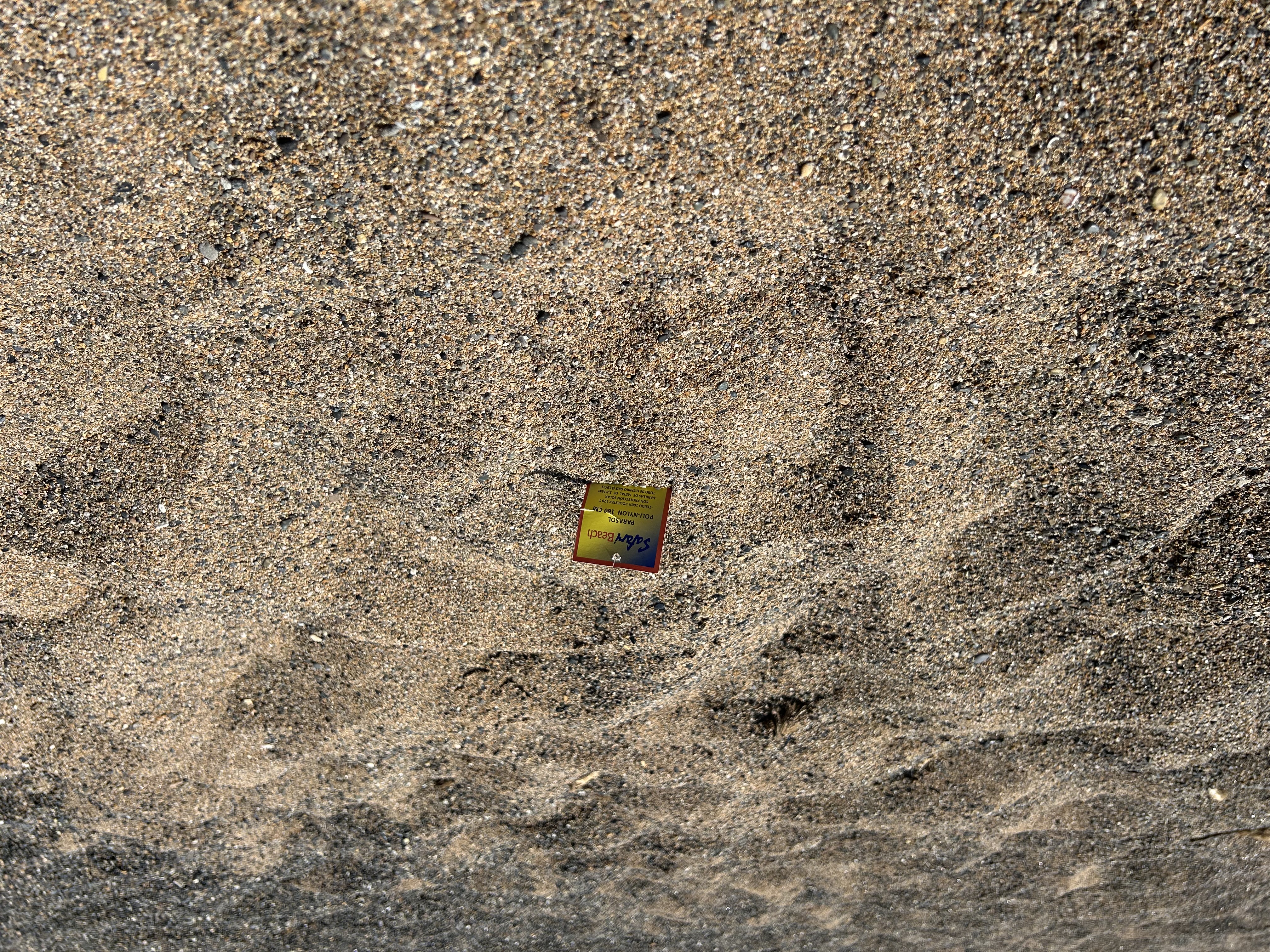
The resemblance to the Sahara is not poetic licence. It is the same physics, shrunk by a factor of roughly ten thousand. I took the photo at Cala Biminel-la, in Menorca. The small card in the sand was dropped by someone. But from my beach chair, it looks like a giant billboard in the desert!
Both desert dunes and beach ripples are formed by a fluid—wind—moving over a granular medium it can almost, but not quite, pick up, but can certainly toss around. When wind speed exceeds a threshold (roughly 5 m/s for dry beach sand), grains begin to saltate: they hop, land, kick up other grains, and set off a chain reaction. A slight irregularity in the surface captures a few extra grains. The bump grows. The bump deflects the airflow, creating a sheltered lee zone where grains settle. The asymmetry is locked in: a gentle windward ramp, a steep slip face on the downwind side, angled at almost exactly 34°—the angle of repose for dry sand.
This is a lovely self-organization of nature. No blueprint, no architect. The pattern writes itself from a local rule applied a billion times: grains move until they can’t, and they can’t a little sooner on the sheltered side, so they pile up.
What makes it a more delightful BS idea is that of scale-independence. The same asymmetric profile, the same characteristic wavelength-to-height ratio, appears in ripples a few centimetres across and in dunes up to hundreds of metres high. In the Sahara and T. E. Lawrence’s Ottoman provinces of Hejaz and Syria, the desert is running the same software as the strip of sand between your towel and the waterline. The beach is just faster—you can watch a ripple field of sand reorganize after a change in wind direction in minutes. The Sahara takes decades or centuries.
🌊 The Network in the Water
Wade into calm, clear, shallow water on a sunny day and look down. The bottom is covered with a shimmering mesh of bright white lines that branch, reconnect, and writhe continuously—a living network that exists nowhere solid, made entirely of light.
These are caustics, the envelope of light rays reflected or refracted by a curved surface or object, or the projection of that envelope of rays on another surface (the sandy bottom) They are among the most beautiful things physics produces, and have some interesting properties in differential geometry.
The water surface is never truly flat. Even in apparent calm it is covered with small, constantly shifting undulations. Each curved patch of surface acts as a tiny lens: it refracts the sunlight passing through it, bending the rays slightly toward or away from each other. Where rays converge on the sandy bottom, you get a bright line. Where they diverge, a dark region. The network you see is the projection of the water surface’s curvature onto the bottom—a real-time map of the shape of the sea surface, written in light.
The lines form a network rather than isolated spots because caustics are curves, not points. Mathematically they are the locus of points where the mapping from surface to bottom becomes singular—many nearby surface points focusing to nearly the same bottom point. The branching junctions where lines meet are called cusps, and they are topologically robust: they survive small changes in surface shape without disappearing, which is why the network maintains its character even as it writhes. This stability is explained by catastrophe theory, which classifies the generic singularities that arise when smooth mappings develop folds.
Shallow water sharpens the pattern. The “focal length” of a surface ripple is short—a few tens of centimetres—so in knee-deep water the caustics are crisp and bright. In deeper water the rays have spread again before reaching the bottom, and you see only a diffuse shimmer. The sweet spot is roughly 0.3–1 m depth, which is exactly where you’re likely to be standing, looking down, wondering what you’re seeing.
🧩 What They Have in Common
Strip away the details and both phenomena tell the same story. A fluid moves across a boundary. The boundary is not passive—it responds, deforms, organizes. The fluid is not uniform—it has turbulence, curvature, threshold effects. From the conversation between the two, emergence arises spontaneously, without instruction.
This is what physicists mean by emergence: the pattern is not in the fluid, and not in the boundary, but in their interaction. Neither sand grain nor photon knows anything about dunes or caustic networks. The patterns are global structures arising from local rules—and they are, in a precise sense, inevitable. Given sand and wind, you will get ripples. Given water and sun, you will get caustics. The beach has no choice but to be interesting.
There is something almost philosophical in this. The most intricate structures we see in nature—from sand dunes to galaxy filaments, from snowflakes to the vessels in a leaf—are not designed. They are the solutions that physics finds when boundary meets fluid and neither one yields completely.
The beach shows you this twice before lunch.
👁️ Look for Yourself
The sand ripples are easiest in the hour after the tide turns, when the surface is freshly reworked and the wind has had time to leave its signature. Crouch down and look along the surface at a low angle: the slip faces cast shadows that make the asymmetry obvious. If the ripple crests are sinuous rather than straight, the wind has been shifting direction—the pattern is mid-negotiation.
The caustics require sun high enough to penetrate the water, calm enough that the surface undulations are gentle rather than choppy, and shallow enough that the focal geometry hasn’t dissolved into blur. Mid-morning on a calm day, 30–80 cm of water, light-coloured sandy bottom. Stand still and watch: the network will rearrange itself continuously, but its topology—the way the lines branch and reconnect—stays recognizably the same. You are watching the water surface think out loud.
Both patterns reward patience and a willingness to look at familiar things as if for the first time. Which is, perhaps, what Beach Science is for.
📚 Further Reading
- Bagnold, R. A. (1941). The Physics of Blown Sand and Desert Dunes. Methuen, London. (Dover reprint, 2005.) The founding text of aeolian geomorphology—Bagnold mapped Libyan dunes, built a wind tunnel, and derived the physics from scratch.
- Ball, Philip (2009). Patterns in Nature: Why the Natural World Looks the Way It Does. University of Chicago Press. Accessible account of self-organization across scales, from sand ripples to zebra stripes to leaf venation.
- Lynch, D. K. & Livingston, W. (2001). “The caustic network.” Color and Light in Nature (2nd ed.). Cambridge University Press. ISBN 978-0-521-77504-5.