glmlist creates a glmlist object containing a list of fitted
glm objects with their names. loglmlist does the same for
loglm objects.
Arguments
- ...
One or more model objects, as appropriate to the function, optionally assigned names as in
list.- object
a
"glmlist"object- result
type of the result to be returned
Value
An object of class glmlist loglmlist, just like a list, except that each model is given a name attribute.
Details
The intention is to provide object classes to facilitate model comparison,
extraction, summary and plotting of model components, etc., perhaps using
lapply or similar.
There exists a anova.glm method for glmlist
objects. Here, a coef method is also defined, collecting the
coefficients from all models in a single object of type determined by
result.
The arguments to glmlist or loglmlist are of the form
value or name=value.
Any objects which do not inherit the appropriate class glm or
loglm are excluded, with a warning.
In the coef method, coefficients from the different models are
matched by name in the list of unique names across all models.
See also
The function llist in package Hmisc is
similar, but perplexingly more general.
The function anova.glm also handles glmlist objects
LRstats gives LR statistics and tests for a glmlist
object.
Other glmlist functions:
Kway(),
LRstats(),
get_model(),
mosaic.glmlist()
Other loglinear models:
assoc_graph(),
get_model(),
joint(),
plot.assoc_graph(),
seq_loglm()
Examples
data(Mental)
indep <- glm(Freq ~ mental+ses,
                family = poisson, data = Mental)
Cscore <- as.numeric(Mental$ses)
Rscore <- as.numeric(Mental$mental)

coleff <- glm(Freq ~ mental + ses + Rscore:ses,
                family = poisson, data = Mental)
roweff <- glm(Freq ~ mental + ses + mental:Cscore,
                family = poisson, data = Mental)
linlin <- glm(Freq ~ mental + ses + Rscore:Cscore,
                family = poisson, data = Mental)

# use object names
mods <- glmlist(indep, coleff, roweff, linlin)
names(mods)
#> [1] "indep"  "coleff" "roweff" "linlin"

# assign new names
mods <- glmlist(Indep=indep, Col=coleff, Row=roweff, LinxLin=linlin)
names(mods)
#> [1] "Indep"   "Col"     "Row"     "LinxLin"

LRstats(mods)
#> Likelihood summary table:
#>            AIC    BIC LR Chisq Df Pr(>Chisq)
#> Indep   209.59 220.19   47.418 15  3.155e-05 ***
#> Col     179.00 195.50    6.829 10     0.7415
#> Row     174.45 188.59    6.281 12     0.9013
#> LinxLin 174.07 185.85    9.895 14     0.7698
#> ---
#> Signif. codes:  0 ‘***’ 0.001 ‘**’ 0.01 ‘*’ 0.05 ‘.’ 0.1 ‘ ’ 1

coef(mods, result='data.frame')
#>                             Indep        Col        Row     LinxLin
#> (Intercept)            4.18756842  4.8631072  4.7061332  3.37942319
#> mental.L               0.04507501  0.6795332 -0.6818052 -0.66051890
#> mental.Q              -0.30073728 -0.3233129 -0.3277282 -0.32176183
#> mental.C               0.39412292  0.3936983  0.1992104  0.39415885
#> ses.L                 -0.04968094 -1.0342736  0.5629992 -0.99933120
#> ses.Q                 -0.30335318 -0.5581022 -0.3328887 -0.33029582
#> ses.C                 -0.19797985 -0.1707521 -0.1979530 -0.19811915
#> ses^4                  0.17490822  0.1230409  0.1749295  0.17494245
#> ses^5                  0.14682648  0.2429662  0.1468266  0.14682693
#> ses1:Rscore                    NA -0.4459213         NA          NA
#> ses2:Rscore                    NA -0.4594090         NA          NA
#> ses3:Rscore                    NA -0.3342208         NA          NA
#> ses4:Rscore                    NA -0.2814884         NA          NA
#> ses5:Rscore                    NA -0.1393421         NA          NA
#> ses6:Rscore                    NA         NA         NA          NA
#> mentalWell:Cscore              NA         NA -0.3068185          NA
#> mentalMild:Cscore              NA         NA -0.1617300          NA
#> mentalModerate:Cscore          NA         NA -0.1433864          NA
#> mentalImpaired:Cscore          NA         NA         NA          NA
#> Rscore:Cscore                  NA         NA         NA  0.09068661

#extract model components
unlist(lapply(mods, deviance))
#>     Indep       Col       Row   LinxLin
#> 47.417847  6.829334  6.280761  9.895124

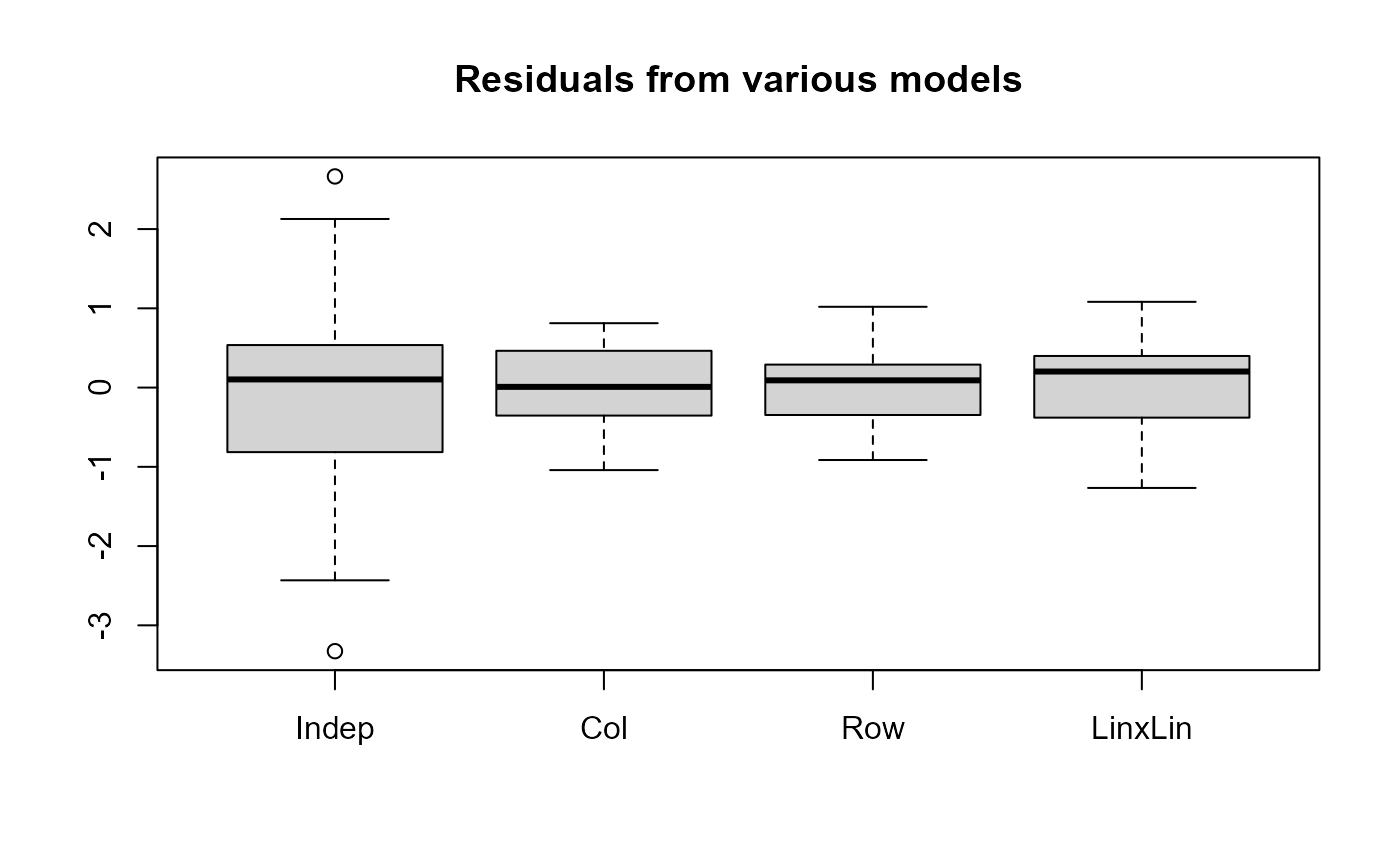
res <- lapply(mods, residuals)
boxplot(as.data.frame(res), main="Residuals from various models")