Construct an undirected graph representing the associations in a loglinear model. Nodes represent variables and edges represent pairwise associations fitted in the model. If two variables are not connected by an edge, they are conditionally independent given the other variables.
Usage
assoc_graph(x, ...)

# S3 method for class 'list'
assoc_graph(x, result = c("igraph", "matrix", "edge_list"), ...)

# S3 method for class 'loglm'
assoc_graph(x, result = c("igraph", "matrix", "edge_list"), ...)

# S3 method for class 'glm'
assoc_graph(
  x,
  result = c("igraph", "matrix", "edge_list"),
  measure = c("none", "chisq", "cramer"),
  ...
)

# S3 method for class 'assoc_graph'
print(x, ...)
Arguments
- x
An object specifying the model. This can be:
A
listof character vectors (a margin/generating class list, as produced byjoint,conditional, etc.)A fitted
loglmobjectA fitted
glmobject (poisson family loglinear model)
- ...
Additional arguments (currently unused).
- result
Type of result to return:
"igraph"(default) returns anigraphobject;"matrix"returns the adjacency matrix;"edge_list"returns a two-column character matrix of edges.- measure
Type of association measure for edge weights (only for
glmmethod):"none"(default) produces an unweighted graph;"chisq"computes partial chi-squared statistics (deviance change when each edge is removed from the model);"cramer"computes Cramer's V from the marginal two-way table for each edge.
Value
Depending on result:
"igraph": Anigraphundirected graph object of classc("assoc_graph", "igraph"), with vertex names corresponding to the variable names. Whenmeasure != "none", edge weights are stored asE(g)$weightand the measure name asg$measure."matrix": A symmetric adjacency matrix with variable names as row and column names. Contains 0/1 when unweighted, or association strength values whenmeasureis specified."edge_list": When unweighted, a two-column character matrix (from, to). Whenmeasureis specified, a data frame with columns from, to, and weight.
Details
Each high-order term (margin) in a hierarchical loglinear model defines a clique
in the association graph. For example, the term c("A", "B", "C") generates
edges A–B, A–C, and B–C. Single-variable terms (as in mutual independence)
yield isolated nodes with no edges.
For loglm objects, the margins are extracted from the $margin component.
For glm objects, the interaction terms are extracted from the model formula.
References
Khamis, H. J. (2011). The Association Graph and the Multigraph for Loglinear Models. SAGE Publications. doi:10.4135/9781452226521
Darroch, J. N., Lauritzen, S. L., & Speed, T. P. (1980). Markov Fields and Log-Linear Interaction Models for Contingency Tables. The Annals of Statistics, 8(3), 522–539. doi:10.1214/aos/1176345006
Whittaker, J. (1990). Graphical Models in Applied Multivariate Statistics. John Wiley & Sons, Chichester.
See also
joint, conditional, mutual,
saturated, loglin2string, seq_loglm,
plot.assoc_graph
Other loglinear models:
get_model(),
glmlist(),
joint(),
plot.assoc_graph(),
seq_loglm()
Examples
# Structural graphs from margin lists (3-way: A, B, C)
mutual(3, factors = c("A", "B", "C")) |> assoc_graph()
#> Association graph: 3 variables, 0 edges
#> Variables: A, B, C
#> Edges: (none -- mutual independence)
#> Model: [A] [B] [C]
joint(3, factors = c("A", "B", "C")) |> assoc_graph()
#> Association graph: 3 variables, 1 edges
#> Variables: A, B, C
#> Edges: A -- B
#> Model: [C] [A,B]
conditional(3, factors = c("A", "B", "C")) |> assoc_graph()
#> Association graph: 3 variables, 2 edges
#> Variables: A, C, B
#> Edges: A -- C, C -- B
#> Model: [A,C] [C,B]
saturated(3, factors = c("A", "B", "C")) |> assoc_graph()
#> Association graph: 3 variables, 3 edges
#> Variables: A, B, C
#> Edges: A -- B, A -- C, B -- C
#> Model: [A,B,C]
# Adjacency matrix form
conditional(3, factors = c("A", "B", "C")) |> assoc_graph(result = "matrix")
#> A C B
#> A 0 1 0
#> C 1 0 1
#> B 0 1 0
# From a fitted loglm model (Berkeley admissions)
if (FALSE) { # \dontrun{
mod <- MASS::loglm(~ (Admit + Gender) * Dept, data = UCBAdmissions)
assoc_graph(mod)
plot(assoc_graph(mod), main = "Berkeley: [AD] [GD]")
} # }
# From glm models (Dayton Survey: cigarette, alcohol, marijuana, sex, race)
data(DaytonSurvey)
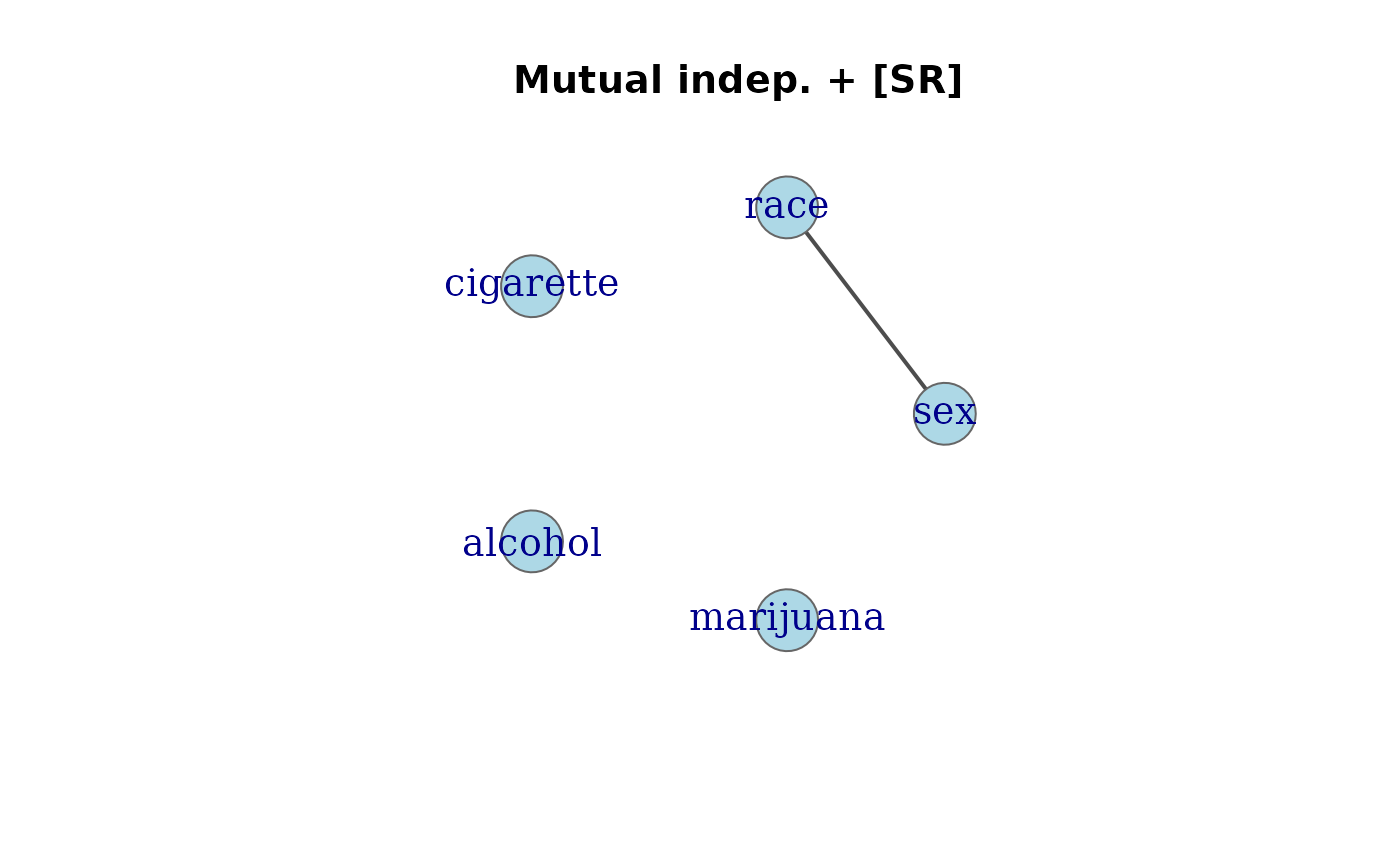
# Mutual independence + sex*race: one edge only
mod.SR <- glm(Freq ~ . + sex*race, data = DaytonSurvey, family = poisson)
assoc_graph(mod.SR)
#> Association graph: 5 variables, 1 edges
#> Variables: sex, race, cigarette, alcohol, marijuana
#> Edges: sex -- race
#> Model: [cigarette] [alcohol] [marijuana] [sex,race]
plot(assoc_graph(mod.SR), main = "Mutual indep. + [SR]")
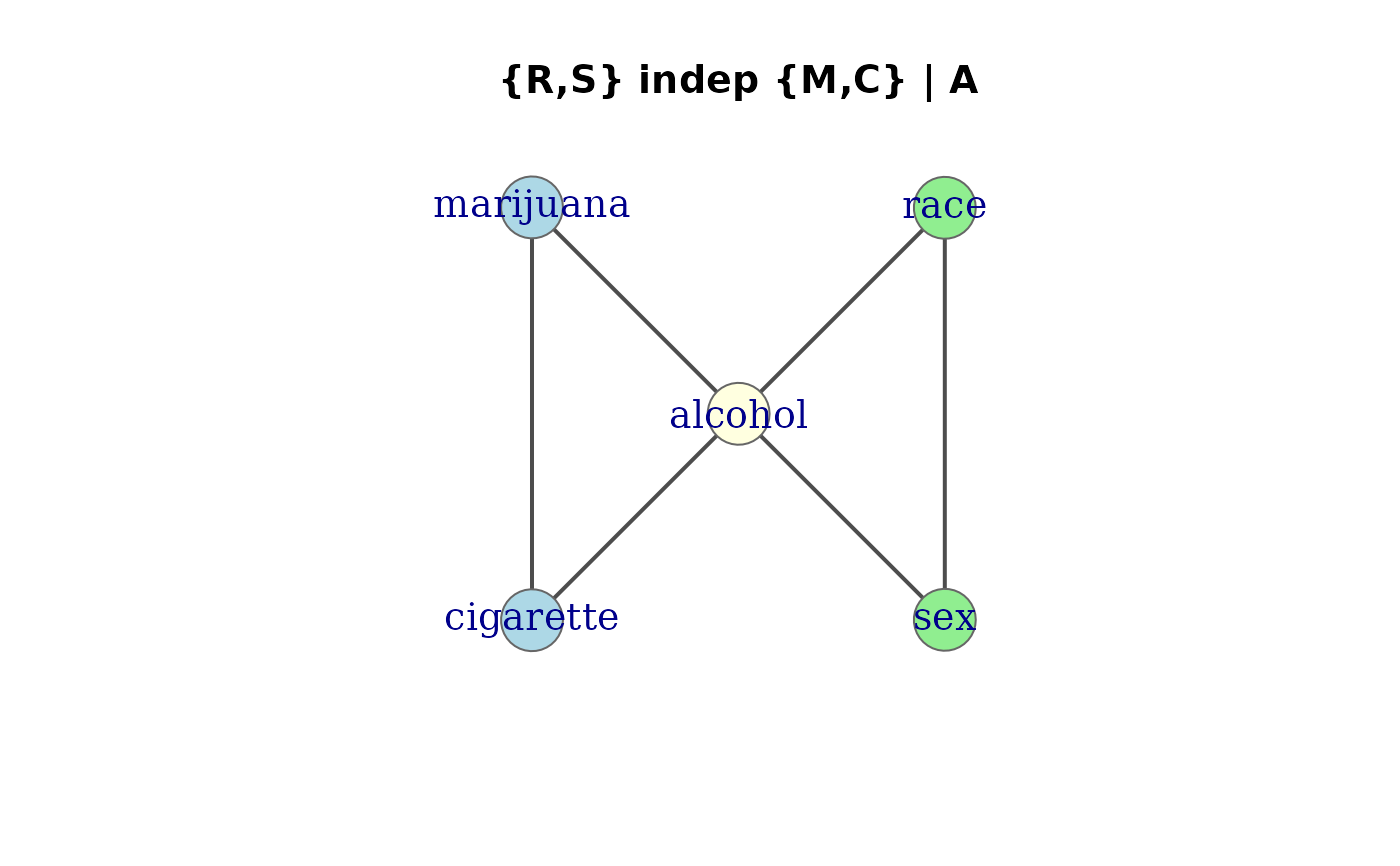
 # [AM][AC][MC][AR][AS][RS]: {race, sex} indep {marijuana, cigs} | alcohol
mod.cond <- glm(Freq ~ (cigarette + alcohol + marijuana)^2 +
(alcohol + sex + race)^2,
data = DaytonSurvey, family = poisson)
# define groups for the model
gps <- list(c("cigarette", "marijuana"),
"alcohol",
c("sex", "race"))
assoc_graph(mod.cond)
#> Association graph: 5 variables, 6 edges
#> Variables: cigarette, alcohol, marijuana, sex, race
#> Edges: cigarette -- alcohol, cigarette -- marijuana, alcohol -- marijuana, alcohol -- sex, alcohol -- race, sex -- race
#> Model: [cigarette,alcohol,marijuana] [alcohol,sex,race]
plot(assoc_graph(mod.cond),
groups = gps,
layout = igraph::layout_nicely,
main = "{R,S} indep {M,C} | A")
# [AM][AC][MC][AR][AS][RS]: {race, sex} indep {marijuana, cigs} | alcohol
mod.cond <- glm(Freq ~ (cigarette + alcohol + marijuana)^2 +
(alcohol + sex + race)^2,
data = DaytonSurvey, family = poisson)
# define groups for the model
gps <- list(c("cigarette", "marijuana"),
"alcohol",
c("sex", "race"))
assoc_graph(mod.cond)
#> Association graph: 5 variables, 6 edges
#> Variables: cigarette, alcohol, marijuana, sex, race
#> Edges: cigarette -- alcohol, cigarette -- marijuana, alcohol -- marijuana, alcohol -- sex, alcohol -- race, sex -- race
#> Model: [cigarette,alcohol,marijuana] [alcohol,sex,race]
plot(assoc_graph(mod.cond),
groups = gps,
layout = igraph::layout_nicely,
main = "{R,S} indep {M,C} | A")
 # Weighted graph: partial chi-squared
g <- assoc_graph(mod.cond, measure = "chisq")
g
#> Association graph: 5 variables, 6 edges
#> Variables: cigarette, alcohol, marijuana, sex, race
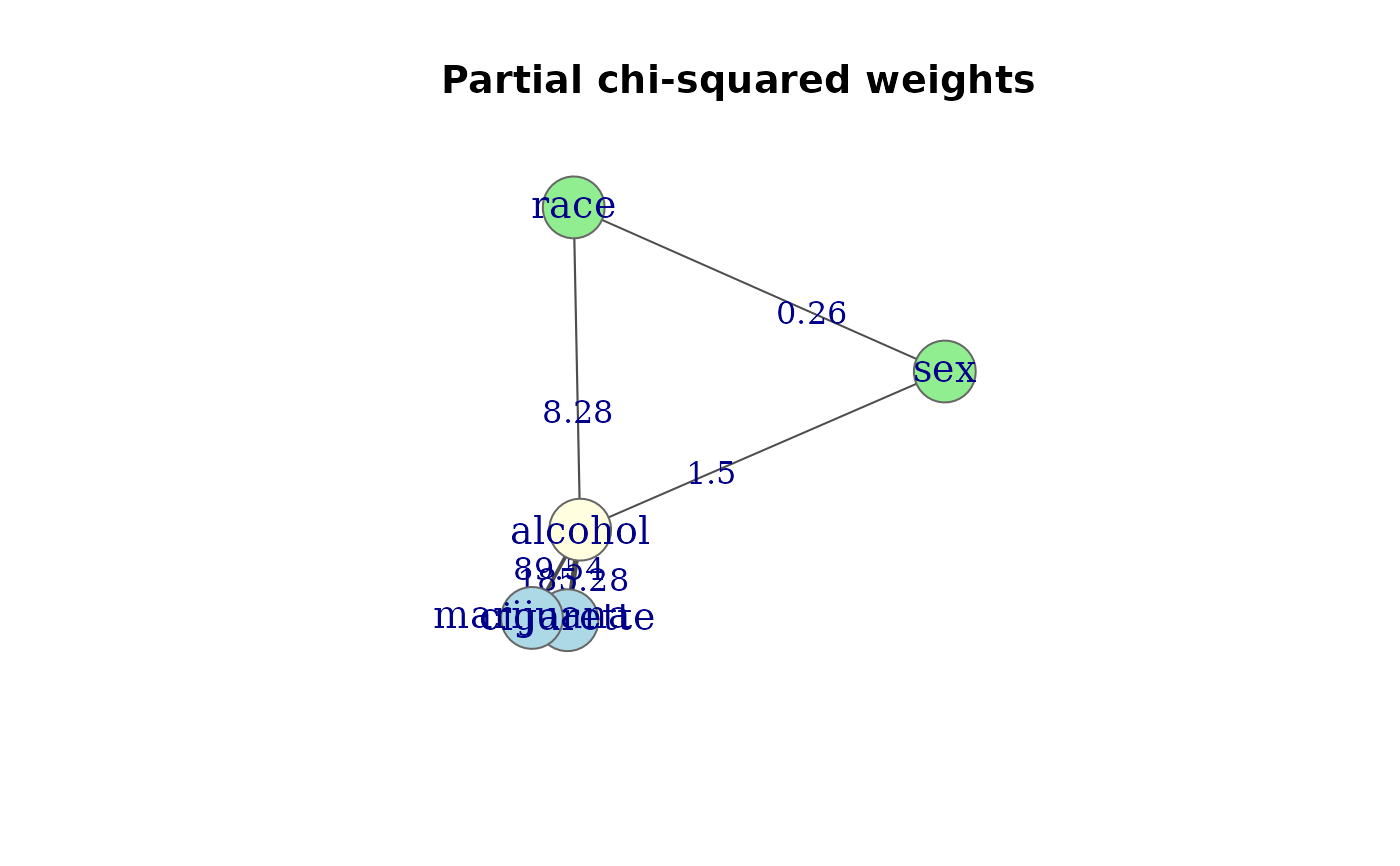
#> Edges: cigarette -- alcohol (185.28), cigarette -- marijuana (494.9), alcohol -- marijuana (89.54), alcohol -- sex (1.5), alcohol -- race (8.28), sex -- race (0.26)
#> Measure: chisq
#> Model: [cigarette,alcohol,marijuana] [alcohol,sex,race]
plot(g, edge.label = TRUE,
groups = gps,
layout = igraph::layout_nicely,
main = "Partial chi-squared weights")
# Weighted graph: partial chi-squared
g <- assoc_graph(mod.cond, measure = "chisq")
g
#> Association graph: 5 variables, 6 edges
#> Variables: cigarette, alcohol, marijuana, sex, race
#> Edges: cigarette -- alcohol (185.28), cigarette -- marijuana (494.9), alcohol -- marijuana (89.54), alcohol -- sex (1.5), alcohol -- race (8.28), sex -- race (0.26)
#> Measure: chisq
#> Model: [cigarette,alcohol,marijuana] [alcohol,sex,race]
plot(g, edge.label = TRUE,
groups = gps,
layout = igraph::layout_nicely,
main = "Partial chi-squared weights")
 # Cramer's V (marginal)
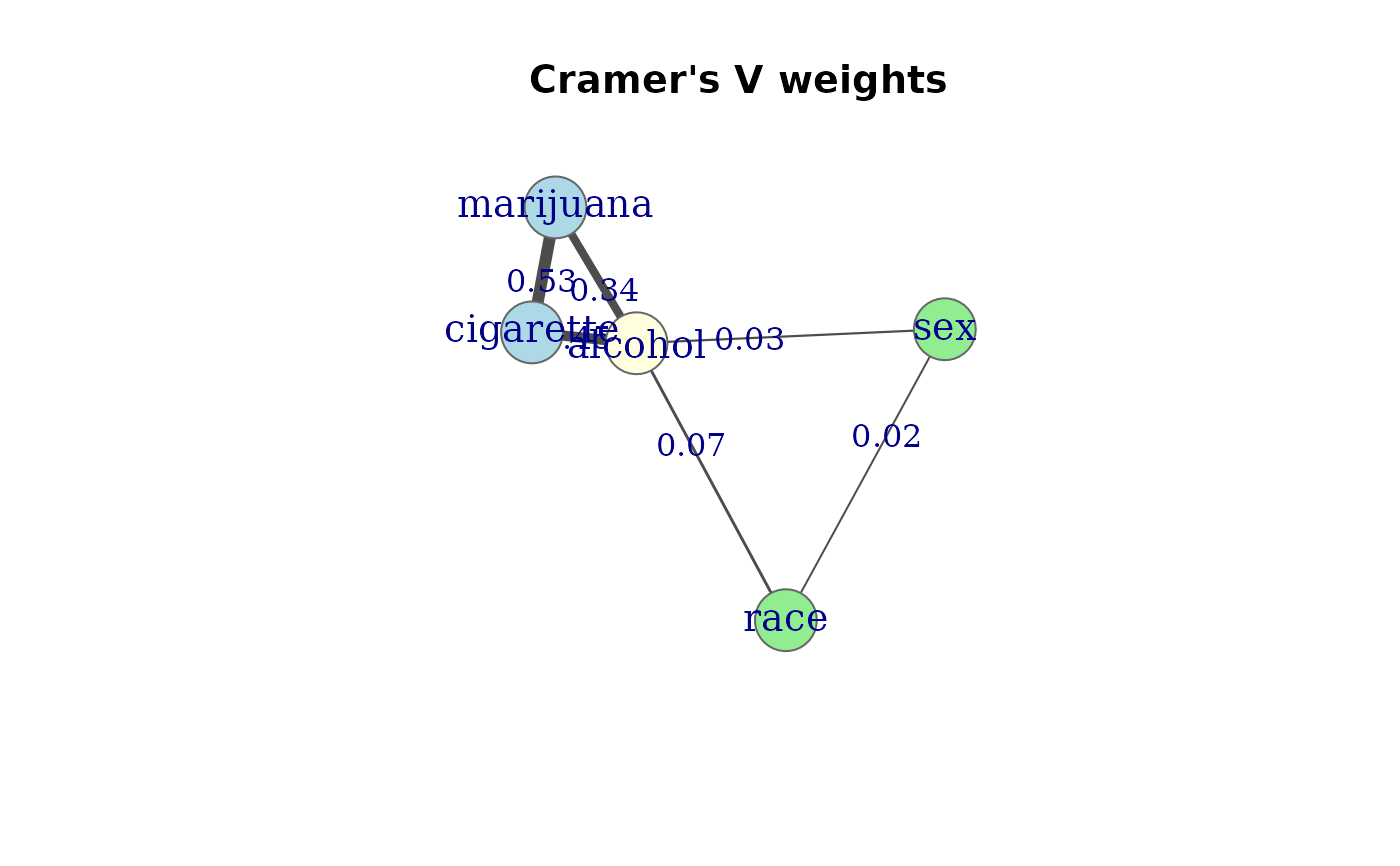
g2 <- assoc_graph(mod.cond, measure = "cramer")
g2
#> Association graph: 5 variables, 6 edges
#> Variables: cigarette, alcohol, marijuana, sex, race
#> Edges: cigarette -- alcohol (0.45), cigarette -- marijuana (0.53), alcohol -- marijuana (0.34), alcohol -- sex (0.03), alcohol -- race (0.07), sex -- race (0.02)
#> Measure: cramer
#> Model: [cigarette,alcohol,marijuana] [alcohol,sex,race]
plot(g2, edge.label = TRUE,
groups = gps,
layout = igraph::layout_nicely,
main = "Cramer's V weights")
# Cramer's V (marginal)
g2 <- assoc_graph(mod.cond, measure = "cramer")
g2
#> Association graph: 5 variables, 6 edges
#> Variables: cigarette, alcohol, marijuana, sex, race
#> Edges: cigarette -- alcohol (0.45), cigarette -- marijuana (0.53), alcohol -- marijuana (0.34), alcohol -- sex (0.03), alcohol -- race (0.07), sex -- race (0.02)
#> Measure: cramer
#> Model: [cigarette,alcohol,marijuana] [alcohol,sex,race]
plot(g2, edge.label = TRUE,
groups = gps,
layout = igraph::layout_nicely,
main = "Cramer's V weights")