Students Page
This page exists only to recognize the contributions of past students in this course and to serve as examples and guidance for current students. It is also a tribute to their work and enthusiasm!
Any materials linked on this page are the intellectual property of the students in this course. They may not be reproduced or used in any other manner without express permission of the student involved. Don’t even think about it.
2026
Team 6136
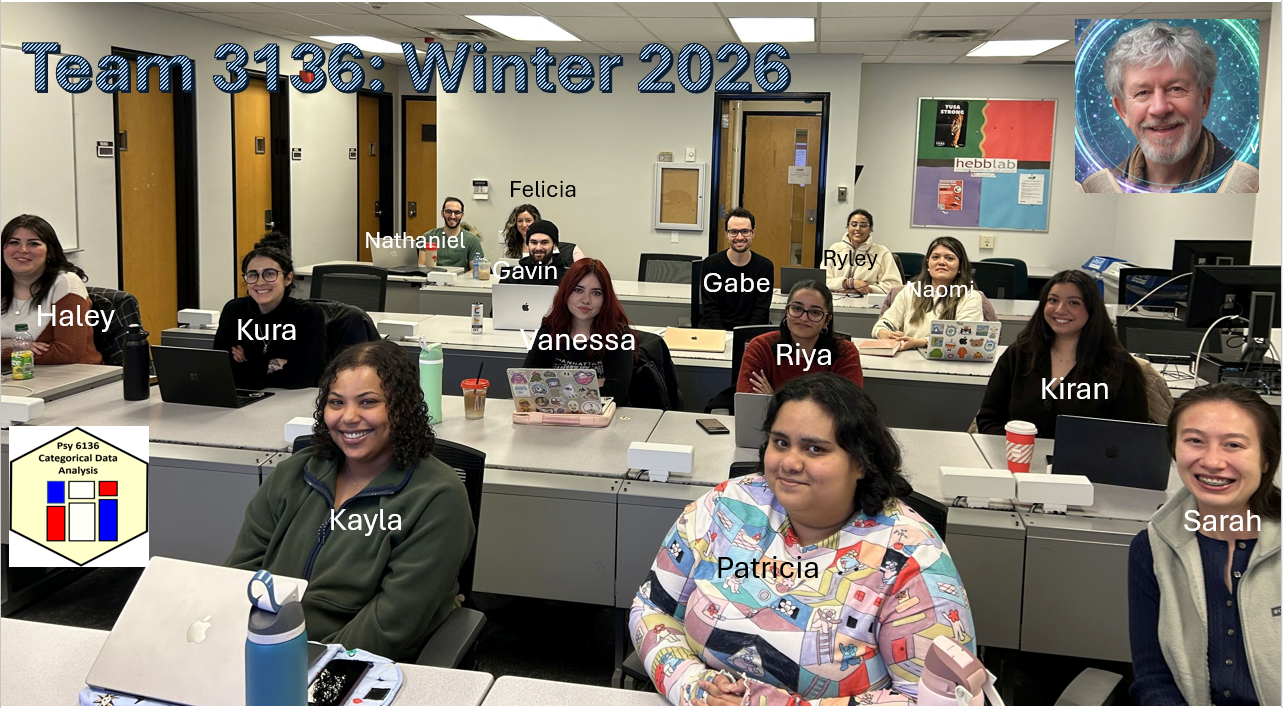
Students in Psych 6136, Winter, 2026
Final Projects

The capstone in this course is a Final Project— a research review paper, a new or unrecognized application area, novel re-framing of methods, extensions of graphical or computational methods— nearly anything extending the scope of CDA in some useful or interesting way.
The Team 6136, 2026 cohort in Psy6136 produced a remarkable collection of final projects spanning a wide territory: latent class analysis of substance/cannabis use patterns; item response theory as a CDA extension; real-time streaming of categorical data; confusion matrices re-framed as contingency tables; history of CDA aspects in criminology; semantic similarity analyzed via MCA and PCA; grasping kinematics in stroke patients, and new tools for tidy categorical data analysis. The breadth and quality of this work reflects both the versatility of categorical data analysis as a field and the inventiveness of this group of students. (Applause here)
Two projects went beyond the usual scope— building software that the
broader R community can use today: Gavin Klorfine contributed six new
functions to the vcdExtra package with important Steps
Toward Tidy CDA and a new vignette. Gabriel Crone & Naomi
Martinez Gutierrez deployed a fully functional Shiny application
for interactive mosaic displays. Several other papers have been
identified as prime candidates for publication in peer-reviewed
journals. (Applause here)
All projects listed below are of sufficient quality for inclusion in Volume 2, Number 1 of the fictitious Journal of Categorical Data Analysis (Spring, 2026). They are listed here, with their links so that they can cite this work, and others can find it.
Vanessa Basurto, Crime in an Analytical World: An Overview of Categorical Data Analysis in Criminology
Haley Bernusky, Latent Class Analysis of Substance Use Patterns: A Tutorial Using NSDUH Data
Kiran Bumra, Clearing Up Confusion: A Categorical Data Analysis Approach to Confusion Matrices
Sarah Campbell, IRT Tutorial: 2PL, Graded Response, and Bifactor Models
Gabriel Crone & Naomi Martinez Gutierrez, Shiny Mosaics: A Shiny Implementation of Interactive Mosaic Displays – App | Writeup
Kyra Farrelly, Latent Class Analysis Tutorial: Understanding Cannabis and Other Drug Usage Patterns | Video tutorial
Gavin Klorfine, Steps Toward Tidy Categorical Data Analysis in R
Ryley Nathaniel, Real-Time Categorical Data Analysis
Felicia Tassone & Nathaniel Goldstein, Utilizing Categorical Data Analysis Methods to Quantify Grasping Kinematics | Video presentation
Riya Trikha, Exploring Free Associations
2023
Team 6136
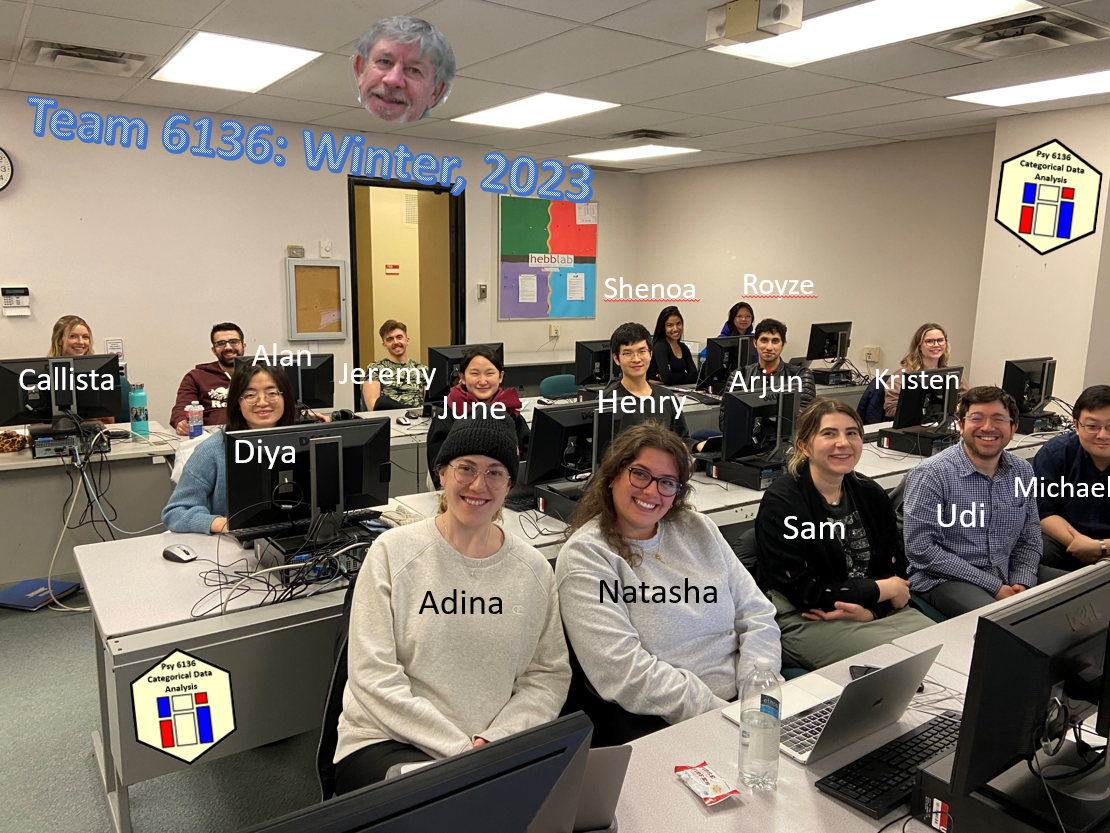
Students in Psych 6136, Winter, 2023
Final Projects
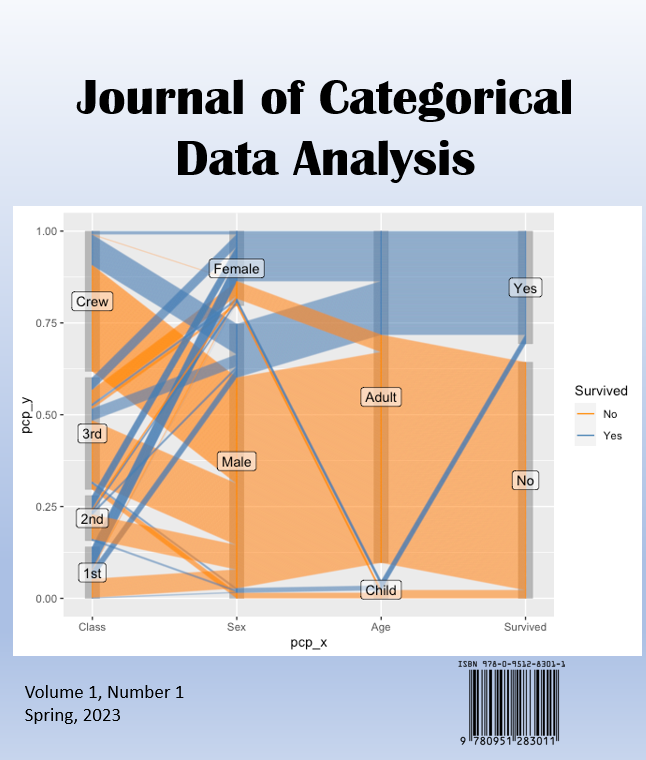
The following projects were submitted in the course. All were of sufficient quality to be forwarded to the nacent Journal of Categorical Data Analysis.
- Feldman, Samantha and Levi, Adina, and Baptist-Mohseni, Natasha. A Broad Review of Categorical Data Analysis in Clinical and Neuropsychology.
- Forsythe, Jeremy and Forchuk, Callista, and Kian Alan . Nascent Areas for Categorical Data Analysis: Describing and Applying Latent Class Analysis (LCA) with a focus on Clinical Psychology Research.
- Lee, Hyeonchung & Kim, Jueun. Predicting the Stay of Removal Decisions.
- Lott, Kristen. Latent Class Analysis for the Social and Behavioural Sciences.
- Simon, Jenny Royze. Recent Developments in Categorical Data Analysis.
- Singh, Arjunvir. Tidy CDA.
- Truong, Michael and Alter, Udi. Throwing a fit: A novel method to properly evaluate goodness-of-fit between discrete distributions.
- Yang, Dia. Analysis of Canadian Refugee Board Stay of Removal Decisions.
Copyright © 2018 Michael Friendly. All rights reserved. || lastModified :
friendly AT yorku DOT ca
 orcid.org/0000-0002-3237-0941